Don't call them "genetically modified" says the FDA. In a campaign that is very likely driven behind-the-scenes by the marketing arm of biotech industry, the FDA now wants us to use the term "genetically engineered" instead.
Why is this so appalling? Because the American public is just beginning to wrap their minds around the term "GMO". That little combination of three letters is gaining widespread comprehension -- "brand recognition" you might say. Recognition that it is the Death Star of our global food supply.
And now that people are starting to recognize all the horrible health and environmental impacts of GMOs , we're supposed to change-out the language.
It's a blatant marketing tactic to confuse the public.
Friday, November 20, 2015

Tuesday, January 20, 2015
How to be an activist based on Good Science

2) Quote good stuff. When you quote, quote "good science" rather than the words of other activists. Quote scientific studies rather than internet articles.
3) Footnote like Fury. Include footnotes or hyperlinks so that others can follow the breadcrumbs back to the sources of your information.
4) Consider the contents. Don't go just by the title alone! Read the study, particularly the conclusion. Make sure it really discovered what you think it discovered, before you quote it.
5) Tell the Truth: tell the public that "the jury is still out", that there are scientific studies on both sides of the argument. Neither side has been conclusively proven yet. GMOs have not been proven safe, nor effective. But honestly, the scientific community has not yet proven GMOs to be completely evil either; they're still working on it (list of studies), so meanwhile that evilness is merely your own opinion.
Now, whether we should go ahead full-scale as a society and bank the future of our entire food supply, the future of our environment, and the health of several generations, on an unproven technology ... that is a question of wisdom.
Good Science vs. Bad Science - How do you tell the difference?
Within activism it is common to hear one side dissing the other with claims of "bad science." The truth is, there are "good science" studies on both sides of the GMO argument. Meanwhile, we activists have some homework to do, so that our statements are founded in "good science" rather than mere opinion.
All science is rooted in exploration: a basic curiosity about how the world works. In the past few hundred years, modern science has developed certain tools so that humanity's investigation of how the world works is a bit more systematic and organized, so that humanity can build a cumulative body of knowledge.
Some of these tools are the Scientific Method (which you learned about in middle school), controlled experiments (which you tried out in high school), and peer-reviewed studies (which you encounter in college). There are established methods for researching the historical body of science, and for building upon that cumulative knowledge.
Peer-reviewed studies mean the work of the authoring scientists was looked over by another group of scientists, typically experts in a particular field. Peer-reviewed studies are published in special scientific journals. This is the highest level of science ( = "good science")
Wednesday, January 7, 2015
The Science of GMOs

But increasingly, scientists in multiple disciplines -- from health to environment to sociology -- are reporting on the undesirable effects of GMO technology.
See our new page "The Science of GMOs" for a listing of these studies.
Saturday, January 3, 2015
Genetically Engineered Crops in Agriculture - video
An overview video in English, with Spanish subtitles.
Wednesday, December 31, 2014
Biotech Lobbyists Pressure LA City Council

"The matter had sailed through a meeting weeks before with only one City Council member expressing doubt.
"But when a council committee sat down to vote again this month, three of the five members came out strongly against it ..." Read the full story
Tuesday, December 9, 2014
What happened?

- Three highly-paid lobbyists representing the pesticide industry influenced a number of the Councilmembers and stopped the bill from moving forward today.
- The bill has been kicked back to the Arts and Parks Committee, but is still alive.
- Around 50-75 concerned citizens were at LA City Hall today. However, the item was pulled from the agenda and citizens were not allowed to speak before the Council even under general comments once the item was pulled.
Wednesday, October 22, 2014
Bill of Rights for Seeds
We the Peoples of this Earth
Gratefully Honor the Ancient Knowledge of Seeds that Nourish and Sustain All Living Beings
1. Seed is the source of life. It is the yearning of life to express itself, to renew, multiply and evolve. We recognize the right of seeds to maintain their vital cycles.
2. We respect the right of seeds to retain their unique identity as distinct, self-regulating organisms.
3. Seeds shall enjoy the right to clean water, the essential element for all life.
Tuesday, October 21, 2014
Los Angeles is going to be a GMO-free Zone!
Today in a historic vote, Los Angeles City Council declared its intention to make L.A. a GMO-free Zone.
That means that we shall soon have an Ordinance (that is an actual law) that says: GMO seeds and plants cannot be grown here! GMO seeds and plants cannot be sold within the L.A. City footprint.
Saturday, October 18, 2014
An organic corn seed producer speaks out
 |
| Link to video |
Watch people hand-pollinate a corn field. This labor-intensive process is what it takes to keep it un-polluted by GMOs.
In the video you'll learn quite a bit about traditional plant breeding, and how GMO-production differs from traditional plant breeding.
Friday, October 17, 2014
The Freedom in Heirloom Seeds

Anna Hunt writes in "Latin American Communities Fight to Protect Heirloom Seeds From Monsanto"
Drought-tolerance: Conventional plant breeding is far better

And here in water-starved California, with a climate-changed future staring down at us, drought tolerance in food crops is a huge issue. Let's face it, genetically altered crops get a big "FAIL!
A recent article in the scientific journal Nature highlighted the efforts of plant breeders from the International Maize and Wheat Improvement Center in Mexico City and the International Institute for Tropical Agriculture in Ibadan, Nigeria. These plant breeders are studying both conventional and transgenic methods in efforts to develop drought-tolerant maize.
"There are already about 153 varieties of conventionally-bred corn currently in trials for drought tolerance," writes blog Civil Eats.
"Researchers say that they are at least 10 years from developing a comparable GM variety," reports Nature.
Drought tolerance is a complex trait that involves multiple genes. Transgenic techniques, which target one gene at a time, have not been as quick to manipulate it.
Traditional plant breeders have been developing drought-tolerant varieties for generations: See selection of varieties from the desert Southwest, available for purchase at Native Seed. With a GMO-Free Zone, we can help preserve them, to feed humanity in a drought-challenged future.
Here they come ... GMO bees
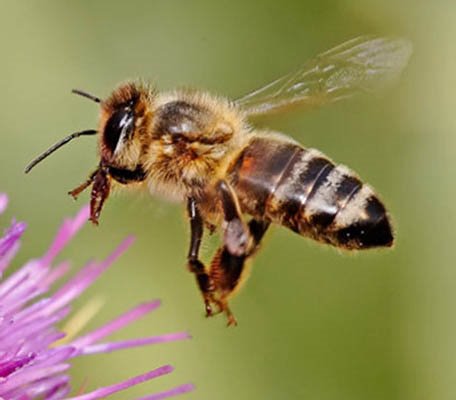
Entomology Today hails it as a "breakthrough in the efforts." But to those of us familiar with the out-of-control dangers of GMO pollen drift, this one is downright scary.
Christina Schulte and colleagues from Heinrich Heine University have apparently figured out not just how to alter genes in honeybees, but how to make those genetic alterations be passed along to offspring. (link to study)
What happens when a few of those GMO bees escape into the wild? Aren't our natural honeybees already under enough attack by modern agriculture? Suspects in Colony Collapse Disorder include ...
- A parasitic mite called Varroa destructor that has often been found in decimated colonies
- Several viruses
- A bacterial disease called European foulbrood that is increasingly being detected in U.S. bee colonies
- The use of pesticides, including neonicotinoids, a neuroactive chemical
- (summary article)
Thursday, October 16, 2014
The Future of Food lies in small-scale agriculture

Hilal Elver, the new United Nations Special Rapporteur on the Right to Food, calls on governments to support a transition to “agricultural democracy” which would empower small farmers.
“Empirical and scientific evidence shows that small farmers feed the world,” said Elver.
"Modern agriculture, which began in the 1950s, is more resource intensive, very fossil fuel dependent, using fertilizers, and based on massive production. This policy has to change." Read a YES magazine article on Elver's speech
Creating a GMO-Free Zone is part of changing these policies. Creating a GMO-Free Zone supports small producers in local urban agriculture.
And a GMO-Free Zone creates a space where we can save the Safe Seeds -- GMO-Free seeds -- which are absolutely essential for the shift away from the erroneous direction of modern agriculture.
Help create a GMO-Free Zone in L.A.
Tuesday, October 14, 2014
Monday, October 13, 2014
GMO crops mean MORE herbicides

"But a new study released by Food & Water Watch ... finds the goal of reduced chemical use has not panned out as planned. In fact, according to the USDA and EPA data used in the report, the quick adoption of genetically engineered crops by farmers has increased herbicide use over the past 9 years in the U.S. The report follows on the heels of another such study by Washington State University research professor Charles Benbrook just last year.
"Both reports focus on 'superweeds.' It turns out that spraying a pesticide repeatedly selects for weeds which also resist the chemical. Ever more resistant weeds are then bred, able to withstand increasing amounts – and often different forms – of herbicide." -- Forbes
Sunday, October 12, 2014
Las Tres Hermanas

The Three Sisters -- corn, bean, and squash plants -- are a traditional planting group for Native American peoples of the desert Southwest, and for Mexican culture.
"Corn or 'maize' is the heart or 'life-force' of Mexico; a staple food of their diet, history, and culture. There are over 20,000 varieties of corn in Mexico and Central America." (source)
Cultural stories, cultural images, and generations-upon-generations of seedsaving heritage are caught up in these plants.
And they are under threat from GMOs.
Saturday, October 11, 2014
GMO crops promote superweeds, food insecurity and pesticides
 |
| link to video |
The Guardian's video talks about superpests and superweeds in India. Similarly, GMO crops are breeding superpests and superweeds right here in the U.S.
We need to shift to a saner method of growing our food. And for that, we need GMO-free seeds (known as Safe Seeds).
Creating a GMO-Free Zone in Los Angeles is an effort to create a clear space -- free of GMO pollution -- where we can grow clean food and save Safe Seeds.
Friday, October 10, 2014
Why heirloom seeds are important
 |
| Link to podcast |
Here is an excellent podcast with Jere Gettle of Baker Creek Seeds.
Jere discusses the loss of diversity in heirloom seeds; the risk, corporate control, and economic problems that come with GMOs; what this loss means for humanity; why save them?
The Campaign for Seed Freedom
Why seeds? Vandana Shiva explains it so eloquently. Seeds are the source of our food.
Here in L.A. we are fighting for the seed. Heirloom seeds should have a right to existence.
In order to have clean food, we need Safe Seeds. We need a clear physical space in which to save Safe Seeds without threat of genetic pollution.
With 13-1374 we are working to create that space. We're starting in our home"town" to create a GMO-free zone where we can preserve and protect heirloom seeds ... which are the future of our food system.
Subscribe to:
Posts (Atom)